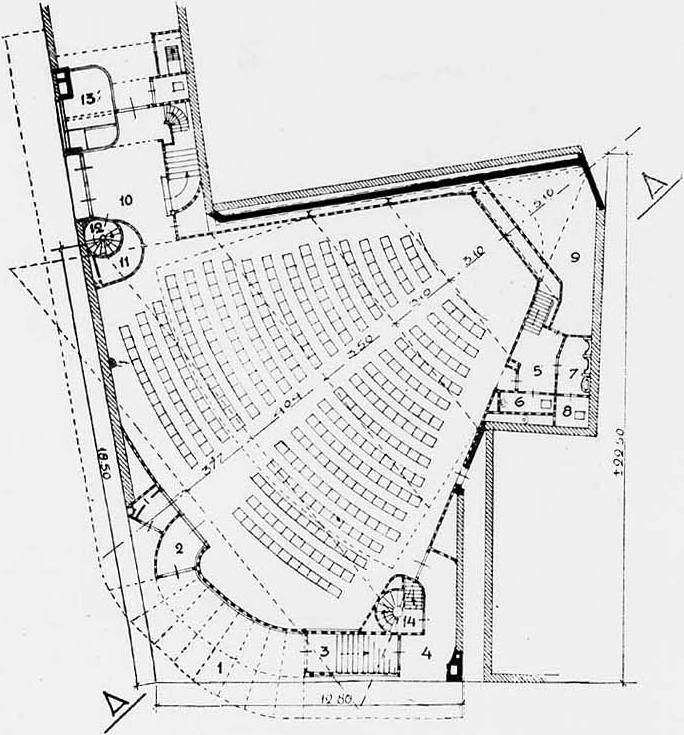
How's this for a first stab at programme...
I've been thinking about the ideas of third space that we discussed, and happened across the cinema as one example. The more I thought about it, the richer it seems as an architectural construct, particularly with regard to our idea of the cast of characters (not in the literal sense of the shared device of 'casts' between our approach and that of the typical film, but rather how the cinema could act as deeply authentic idea of a place where the lives of the characters can intersect, both with each other and, simultaneously, with lives of characters on screen) and also as the ultimate liminal space, a space of suspended narration, where notions of real and unreal collide, enmesh, slip by, and then, when the lights come on, the world as we know it is restored (see your earlier reference to 'Alice in Wonderland' perhaps?).
It also seems to embody many of the notions espoused in the brief. I have always found the forced intimacy and faux-domesticity of the cinema situation fascinating; it really seems to tread the ground between 'house' and 'common room' in a way that no other programmatic element I have come across thus far can do. In addition, it is a facility that the city of Limerick is lacking, and one for which the need is evident, at least to me. The typology of cinemas in Limerick is very much that of the vernacular 'pedimented shed', and so it seems as though there is something there to work with on that front too.
The following beautifully evocative quote about the pull of the cinema is by Elizabeth Bowen, from J. Richards,
The Age of the Dream Palace, p.23, as quoted by Tom de Paor in the essay entitled
Delay, contained in 'The Lives of Spaces'
"I go to the cinema for any number of different reasons - these I ought to sort out and range in order of their importance. At random, here are a few of them; I go to be distracted (or 'taken out of myself'); I go when I don't want to think; I go when I do want to think and need stimulus; I go to see pretty people; I go when I want to see life ginned up, charged with unlikely energy; I go to laugh; I go to be harrowed; I go when a day has been such a mess of detail that I am glad to see even the most arbitrary, the most preposterous pattern emerge; I go because I like bright lights, abrupt shadows, speed; I go to see America, France, Russia; I go because I like wisecracks and slick behaviour; I go because the screen is an oblong opening into the world of fantasy for me; I go because I like story, with its suspense; I go because I like sitting in a packed crowd in the dark, among hundreds riveted on the same thing; I go to have my most general feelings played on. These reasons, put down roughly, seem to fall under five headings; wish to escape, lassitude, sense of lack in my nature or my surroundings, loneliness (however passing) and natural frivolity."
I think that a lot of the experiences Bowen describes here dovetail very neatly with our initial discussions on the temperaments and motivations of our characters, and there is also a very nice sense of the mercurial nature of the individual, which the Invisible Cities discussion, and the expression of that in the cast (as both discrete entities and united whole simultaneously), were beginning to get at.